
Analysts expect the Gracey curette market to grow at close to 10% a year — fast for a hand instrument that has existed since the 1940s. Understanding why demand keeps rising helps clinics plan purchasing, distributors plan ranges and manufacturers plan capacity. Here are the main drivers, supported by public health and labour data.
Key takeaways
- About 42% of US adults aged 30+ have periodontitis (CDC/NIDCR).
- Severe gum disease affects around 1 billion people worldwide (WHO).
- US dental hygienist employment is projected to grow 7% from 2024 to 2034 (BLS).
- Innovation in shanks, blades, handles and materials keeps replacement demand high.
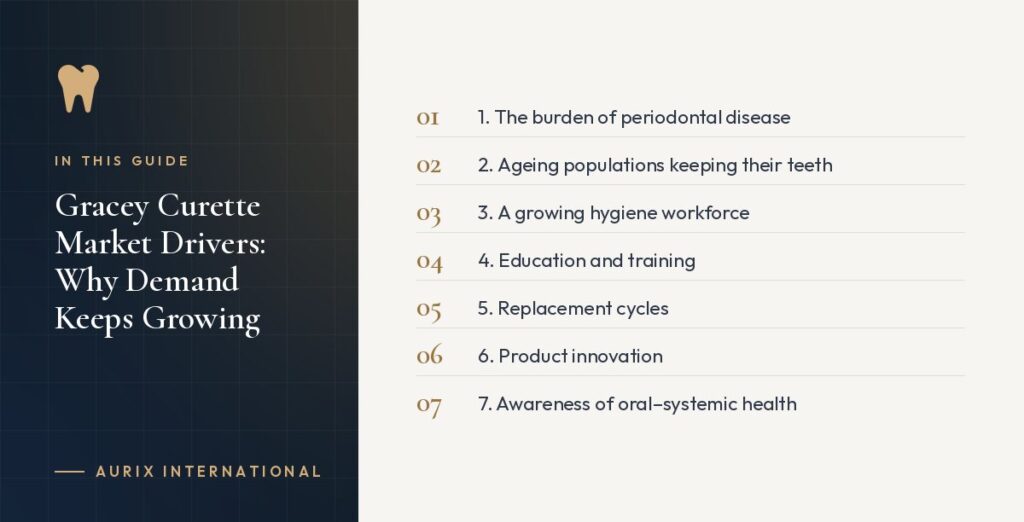
1. The burden of periodontal disease
Gracey curettes exist to treat periodontal disease. According to NIDCR analysis of NHANES 2009–2014 data, 42.2% of dentate US adults aged 30 and over had periodontitis, including 7.8% with severe disease. Globally, the World Health Organization’s 2022 oral health report estimates that severe periodontal disease affects about one billion people. Every patient needing scaling, root planing or periodontal maintenance creates instrument use — and instrument wear.
2. Ageing populations keeping their teeth
People are retaining natural teeth longer. Older adults have higher rates of periodontitis and more complex root anatomy, increasing demand for area-specific instruments, extended shanks and mini blades that reach deep pockets and furcations.
3. A growing hygiene workforce
The US Bureau of Labor Statistics projects dental hygienist employment to grow 7% between 2024 and 2034, with around 15,300 openings each year. Every new hygienist and hygiene operatory needs a full Gracey set — and spares in rotation for sharpening.
4. Education and training
Dental and hygiene schools issue Gracey sets to every student, often refreshed as students progress. Growing programmes in emerging markets add to this demand.
5. Replacement cycles
Curettes are sharpened repeatedly and gradually lose blade width. Once a blade becomes thin it must be replaced to avoid fracture in the pocket. This built-in replacement cycle creates steady recurring demand. See sharpening curettes and scalers.
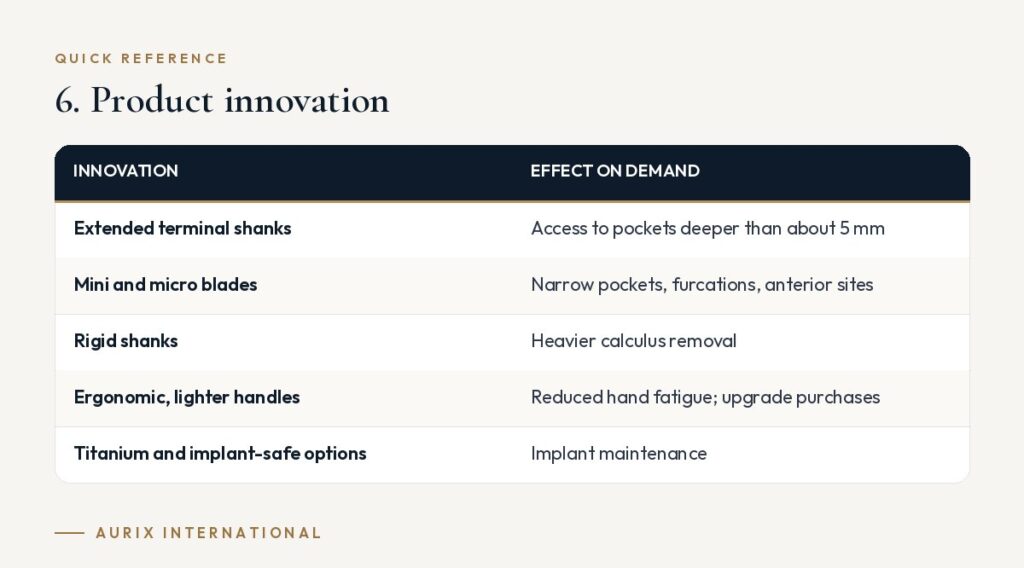
6. Product innovation
| Innovation | Effect on demand |
|---|---|
| Extended terminal shanks | Access to pockets deeper than about 5 mm |
| Mini and micro blades | Narrow pockets, furcations, anterior sites |
| Rigid shanks | Heavier calculus removal |
| Ergonomic, lighter handles | Reduced hand fatigue; upgrade purchases |
| Titanium and implant-safe options | Implant maintenance |
Mordor Intelligence identifies micro/mini variants and titanium instruments among the fastest-growing segments. See market by product type.
7. Awareness of oral–systemic health
Growing public and professional attention to links between periodontal health and general health encourages earlier and more regular periodontal care, sustaining hygiene visits.
Restraints to keep in mind
- Price pressure from low-cost imports.
- Quality variation between manufacturers.
- Competition from ultrasonic scaling for some tasks — though hand instruments remain essential for root planing and fine debridement.
See market challenges.
What the drivers mean for buyers
Steady demand means good availability and growing choice. The challenge is choosing well: patterns, shank types, steel quality and handle ergonomics all matter. Our Gracey curette buyer’s guide walks through the decision.
How replacement demand is calculated
A simple way to see the recurring nature of the market is to estimate replacements per hygienist. If a hygienist works with four core Gracey patterns, keeps three sets in rotation and replaces each curette when sharpening has thinned the blade, the operatory may need a dozen or more new curettes every year — before adding anterior, extended-shank or implant patterns. Multiply that across hundreds of thousands of hygienists worldwide and the steady baseline of the market becomes clear.
Drivers by buyer type
| Buyer | Main driver |
|---|---|
| General practices | Recall visits and periodontal maintenance |
| Periodontal practices | Complex cases needing specialised patterns |
| Schools | Growing hygiene cohorts and sharpening practice |
| Groups and DSOs | New locations and standardised sets |
| Distributors | Range expansion and private label |
If your practice is seeing more periodontal patients, it is worth reviewing whether your sets include the patterns you now need; you can compare options in our Gracey curettes range.
Frequently asked questions
What is the biggest driver of the Gracey curette market?
The high prevalence of periodontal disease, combined with a growing hygiene workforce.
Will ultrasonic scalers replace Gracey curettes?
Unlikely. Most clinicians combine both. See ultrasonic scalers vs Gracey curettes.
Equip your hygiene team. Explore surgical-grade stainless steel Gracey curettes from Aurix International. Shop Gracey curettes →
Sources: NIDCR; WHO report coverage; BLS; Mordor Intelligence.