
Orthodontic practices depend on pliers and cutters that stay aligned and sharp through thousands of adjustments. When a favourite Weingart or distal end cutter wears out, orthodontists want an identical replacement — same pattern, same feel, same finish. An orthodontic instruments supplier therefore needs to deliver precision consistently and keep doing so for years. This guide explains what to look for, how to evaluate pliers and how to build standard chair sets.
Key takeaways
- Check beak alignment, joint firmness and cutting edges before buying.
- Tungsten carbide edges usually last much longer on cutters.
- Standard chair sets make it easy to add chairs and train assistants.
- Choose a supplier who can match patterns for future replacements.
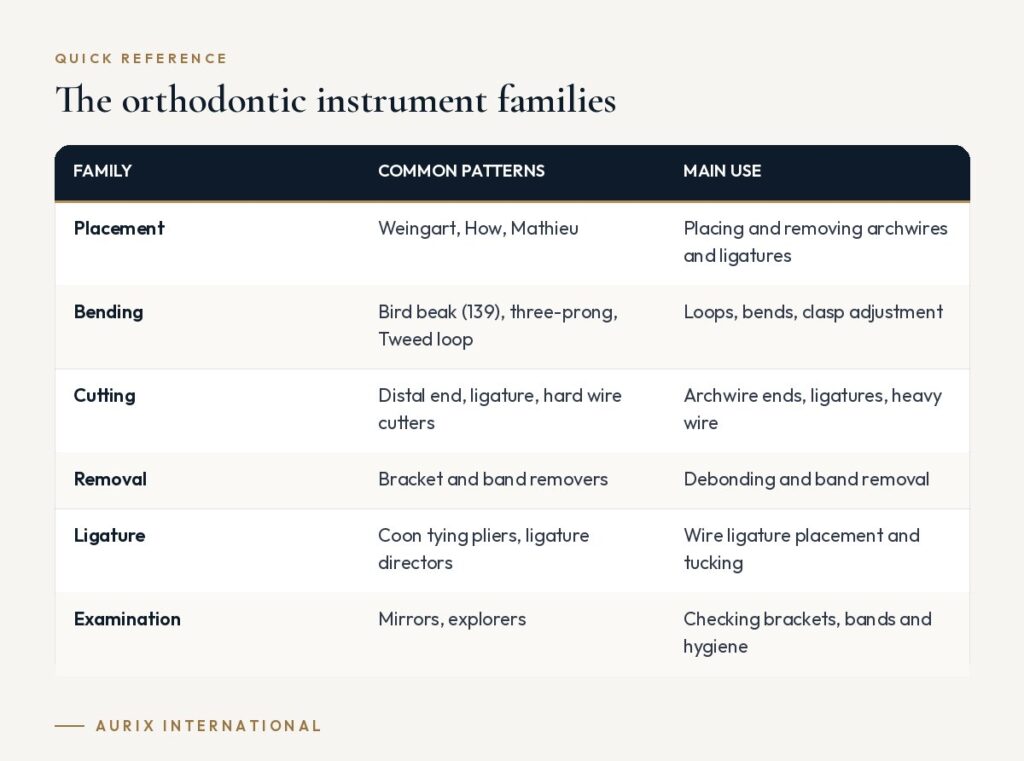
The orthodontic instrument families
| Family | Common patterns | Main use |
|---|---|---|
| Placement | Weingart, How, Mathieu | Placing and removing archwires and ligatures |
| Bending | Bird beak (139), three-prong, Tweed loop | Loops, bends, clasp adjustment |
| Cutting | Distal end, ligature, hard wire cutters | Archwire ends, ligatures, heavy wire |
| Removal | Bracket and band removers | Debonding and band removal |
| Ligature | Coon tying pliers, ligature directors | Wire ligature placement and tucking |
| Examination | Mirrors, explorers | Checking brackets, bands and hygiene |
See our orthodontic pliers guide for detail on each pattern.
How to evaluate orthodontic pliers
- Beak alignment: close the pliers and hold them to the light; beaks should meet evenly along their length.
- Joint quality: movement should be smooth and firm, with no lateral play.
- Cutting edges: cutters should cut ligature wire cleanly at the tip without crushing it.
- Safety hold: distal end cutters should hold the cut piece securely.
- Finish: no burrs that could catch soft tissue.
- Durability: after repeated sterilisation the joint should not stiffen or loosen.
Steel, carbide and joints
Pliers are typically made from hardened stainless steel; cutters often use tungsten carbide inserts for longer-lasting edges. Box joints and well-fitted screw joints resist loosening. Ask your supplier which material is used for cutting edges, whether inserts can be serviced and how joints are constructed.
Supplier capabilities to look for
- A complete ortho range so you can standardise.
- Organised sets such as the Aurix Orthodontic Wire Control System.
- Advice on care, lubrication and edge maintenance.
- Pattern matching for replacements.
- Kits in cassettes for organised reprocessing.
Building a standard chair set
| Category | Instruments per chair |
|---|---|
| Placement | Weingart, How, Mathieu |
| Bending | Bird beak, three-prong |
| Cutting | Distal end cutter, ligature cutter |
| Ligature | Ligature director/tucker |
| Examination | Mirror, explorer |
| Spares | One spare of the two most-used instruments per chair |
Identical sets in identical cassettes make it simple to add chairs and train new assistants.
Care advice a good supplier should give
- Clean promptly and open pliers fully during ultrasonic cleaning and sterilisation.
- Dry thoroughly and lubricate joints after sterilisation.
- Never cut wire heavier than a cutter’s rating.
- Store pliers so tips do not knock together.
Repair, replacement and spares
High-use pliers and cutters wear. Some can be serviced by realigning joints or replacing carbide inserts; others are better replaced. Keeping a spare of each critical instrument per chair avoids appointment delays while an instrument is serviced.
Why consistency matters
Orthodontists develop a feel for each instrument — how much force a bend takes, how a cutter engages. A replacement of a different pattern or quality changes that feel. A supplier who can supply the same pattern and finish year after year protects clinical consistency.
Frequently asked questions
Are tungsten carbide cutters worth it?
For high-volume practices, yes: carbide edges usually last considerably longer than plain steel.
Should general dentists offering orthodontics buy a full set?
A core set covering placement, cutting and ligature instruments is usually enough to start.
How should ortho pliers be sterilised?
Follow the manufacturer’s reprocessing instructions; most stainless pliers are steam-sterilised with joints open, then lubricated.
Next steps
Explore the Orthodontic Wire Control System, contact us, or see our US supplier overview.