Scalers remove heavy supragingival calculus. Unlike curettes, they have pointed tips and are generally used above the gumline or just below it. Choosing the right scaler makes calculus removal faster and less tiring.
Sickle scalers
Sickle scalers have a curved blade that comes to a sharp point, with a triangular cross-section and two cutting edges. They are ideal for removing calculus from the proximal surfaces of anterior and posterior teeth. Popular patterns include the H6/H7 for anteriors and 204S for posteriors.
Jacquette scalers
Jacquette scalers have straight blades with a pointed tip. They are particularly useful on anterior teeth and on interproximal surfaces with tight contacts.
Hoe scalers
Hoe scalers have a blade bent at about 100 degrees to the shank, with a single straight cutting edge. They pair with a pull stroke to remove heavy, tenacious calculus, mainly on buccal and lingual surfaces. Less common today, but still valued by some clinicians.
Files and chisels
Periodontal files have several small cutting edges and crush or roughen heavy calculus deposits before other instruments remove them. Chisel scalers are pushed from facial to lingual to remove deposits from anterior proximal surfaces.
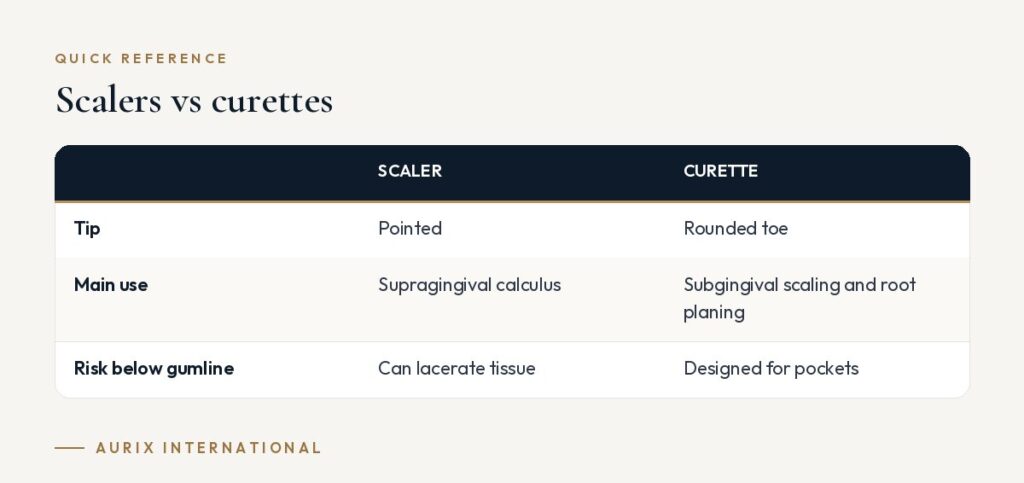
Scalers vs curettes
| Scaler | Curette | |
|---|---|---|
| Tip | Pointed | Rounded toe |
| Main use | Supragingival calculus | Subgingival scaling and root planing |
| Risk below gumline | Can lacerate tissue | Designed for pockets |
Building a hygiene tray
A typical hygiene tray includes a mirror, probe, explorer, one anterior and one posterior sickle scaler, and a selection of curettes.
Sharpness and safety
Dull scalers burnish calculus instead of removing it, leaving a smooth layer that is harder to remove later. Sharpen regularly and check the point under magnification.
Aurix International lists scalers individually and as part of periodontal kits. Ask us about available patterns.