
Curettes come in two main families: universal and area-specific. Both are used for scaling and root planing, but they are designed differently and suit different situations.
Universal curettes
Universal curettes, such as the Columbia 13/14 and Barnhart 5/6, have a blade at 90 degrees to the terminal shank and two usable cutting edges. One instrument can be adapted to most teeth and surfaces by changing hand position.
Pros
- Fewer instruments needed.
- Quick to learn.
- Good for supragingival and shallow subgingival work.
Cons
- Less precise adaptation in deep pockets.
- Harder to access difficult root anatomy.
Area-specific (Gracey) curettes
Gracey curettes have an offset blade (about 70 degrees) and only one cutting edge per blade. Each pair is designed for a specific area and surface.
Pros
- Excellent adaptation in deep pockets.
- Better access to root concavities and furcations.
Cons
- More instruments required.
- Choosing the correct instrument takes practice.
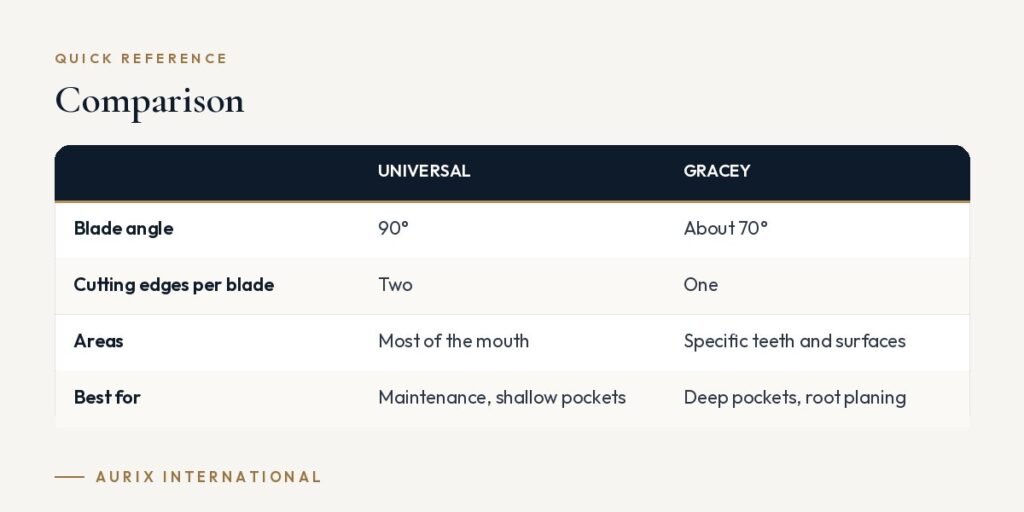
Comparison
| Universal | Gracey | |
|---|---|---|
| Blade angle | 90° | About 70° |
| Cutting edges per blade | Two | One |
| Areas | Most of the mouth | Specific teeth and surfaces |
| Best for | Maintenance, shallow pockets | Deep pockets, root planing |
Combining both
Most hygiene kits combine a universal curette for general debridement with a selection of Graceys for deeper sites. A practical combination is a Columbia 13/14 plus Gracey 5/6, 11/12 and 13/14.
Choosing handles
Lighter, wider handles reduce pinch force and help prevent hand fatigue during long hygiene days. Consider handles with textured grips and a diameter of around 9–10 mm.
Build a hygiene set with your preferred curettes through our custom kits service.