
A needle holder must hold a curved needle firmly without rotating, release it cleanly and be comfortable enough for precise movements. The pattern you choose depends on the suture size and the type of surgery.
Main patterns
Mayo-Hegar
The Mayo-Hegar is the classic needle holder, with ring handles, a ratchet lock and serrated jaws. It is robust and works well with the 3-0 and 4-0 sutures common in general oral surgery.
Crile-Wood
The Crile-Wood has narrower jaws than the Mayo-Hegar, giving a finer grip on smaller needles while remaining strong.
Castroviejo
The Castroviejo has spring handles held like a pen and fine jaws. Also, it allows precise wrist rotation and is preferred for microsurgery, periodontal plastic surgery and implant work with 5-0 to 7-0 sutures.
Olsen-Hegar
The Olsen-Hegar combines a needle holder and suture scissors in one instrument, saving an instrument change but requiring care so that the suture is not cut accidentally.
Jaw types
- Serrated jaws grip well but can damage fine needles.
- Smooth jaws are kind to fine needles but need more pressure.
- Tungsten carbide inserts hold needles very securely and last longer; they are usually identified by gold handles.
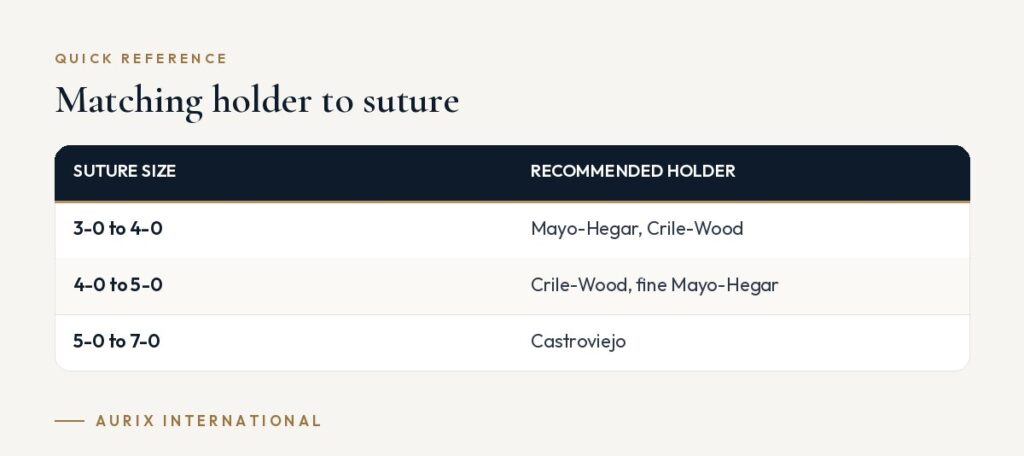
Matching holder to suture
| Suture size | Recommended holder |
|---|---|
| 3-0 to 4-0 | Mayo-Hegar, Crile-Wood |
| 4-0 to 5-0 | Crile-Wood, fine Mayo-Hegar |
| 5-0 to 7-0 | Castroviejo |
How to grip the needle
Hold the needle about two-thirds of the way from the point, at the tip of the jaws. Gripping too close to the swaged end can bend the needle or cause it to break.
Care
Check that jaws close evenly and that the ratchet engages and releases smoothly. Worn jaws let needles rotate; tungsten carbide inserts can often be replaced by a specialist.
Explore needle holders and needle drivers from Aurix International, or ask us to include your preferred pattern in a suturing kit.