
Surgery is only as good as the visibility. Retractors hold soft tissue — cheeks, lips, tongue and flaps — out of the way so the clinician can see and work safely. Each common pattern has a specific job.
Cheek and lip retractors
Minnesota retractor
The Minnesota is a flat, curved, offset retractor used to hold back the cheek and a reflected flap at the same time. It is one of the most versatile retractors in oral surgery.
Austin retractor
The Austin has a right-angled blade and is used to retract the cheek, tongue or a flap, particularly in the posterior mouth.
Flap retractors
Seldin retractor
The Seldin is a broad, flat instrument that retracts a mucoperiosteal flap and can also be used as a periosteal elevator.
Prichard retractor
Similar in role to the Seldin, the Prichard is popular in periodontal and implant surgery for holding flaps away from the bone.
Tongue retractors
Weider retractor
The Weider is a broad, heart-shaped retractor with a serrated surface that holds the tongue away from the surgical site, especially for lower third molar surgery.
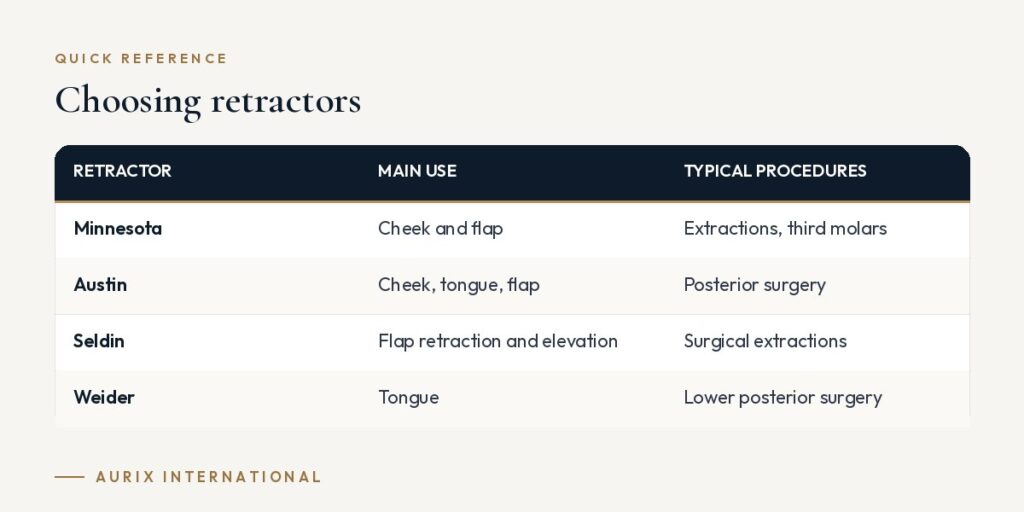
Choosing retractors
| Retractor | Main use | Typical procedures |
|---|---|---|
| Minnesota | Cheek and flap | Extractions, third molars |
| Austin | Cheek, tongue, flap | Posterior surgery |
| Seldin | Flap retraction and elevation | Surgical extractions |
| Weider | Tongue | Lower posterior surgery |
Tips for assistants
- Retract steadily: frequent movement disturbs the surgeon’s view.
- Rest the retractor on bone, not on the flap edge, to avoid crushing tissue.
- Watch the lip commissure; prolonged pressure can cause bruising.
Care
Retractors are simple to clean, but check for bends and burrs that could tear soft tissue. A bent retractor should be replaced rather than straightened.
Aurix lists retractors in its catalogue and includes them in surgical kits. Ask us which patterns suit your procedures.