Extraction forceps are among the most-used instruments in any general or surgical practice, and among the easiest to buy badly. A forceps that looks right in a catalogue photo can still slip on a root, flex under load or rust after a few autoclave cycles. This guide explains how forceps are designed and what to look for so that every pair you buy earns its place on the tray.
How extraction forceps work
Every forceps has three parts: the beaks that grip the tooth, the joint (hinge) that transfers force, and the handles that the clinician holds. The beaks are shaped to follow the anatomy of a specific tooth or group of teeth, so the instrument grips the root surface below the crown rather than crushing enamel. The handles provide leverage; the joint must open smoothly without side-to-side play.
Patterns a typical clinic needs
Forceps are numbered by pattern. Numbering systems vary between manufacturers, so always compare the beak shape rather than relying on the number alone. A practical starter range covers:
- Upper anteriors — straight handles and beaks for incisors and canines.
- Upper premolars — a gentle S-curve so the beaks reach the arch without the handles hitting the lower lip.
- Upper molars — left and right patterns with a pointed buccal beak that engages the trifurcation.
- Lower anteriors and premolars — handles at roughly a right angle to the beaks.
- Lower molars — two pointed beaks that sit in the bifurcation (the “cowhorn” style takes this further).
- Root fragments — narrow, fine beaks for retained roots.
What to check before you buy
Beak fit and serrations
Close the forceps and hold it to the light. The beaks should meet evenly along their length, and the serrations should be crisp enough to grip but not sharp enough to cut. Poorly finished serrations either polish smooth quickly or tear the periodontal ligament.
Joint quality
Open and close the instrument a dozen times. It should move smoothly with no grinding and no lateral wobble. A loose joint wastes force and makes the beaks twist on the root.
Steel and finish
Look for surgical-grade stainless steel that has been hardened and passivated. A satin finish reduces glare under the operating light; a mirror finish is easier to inspect for debris. Either is fine if the steel is right.
Handle shape and grip
Handles should fill the hand without forcing the fingers wide apart. Serrated or textured handles help when gloves are wet.
Universal vs tooth-specific forceps
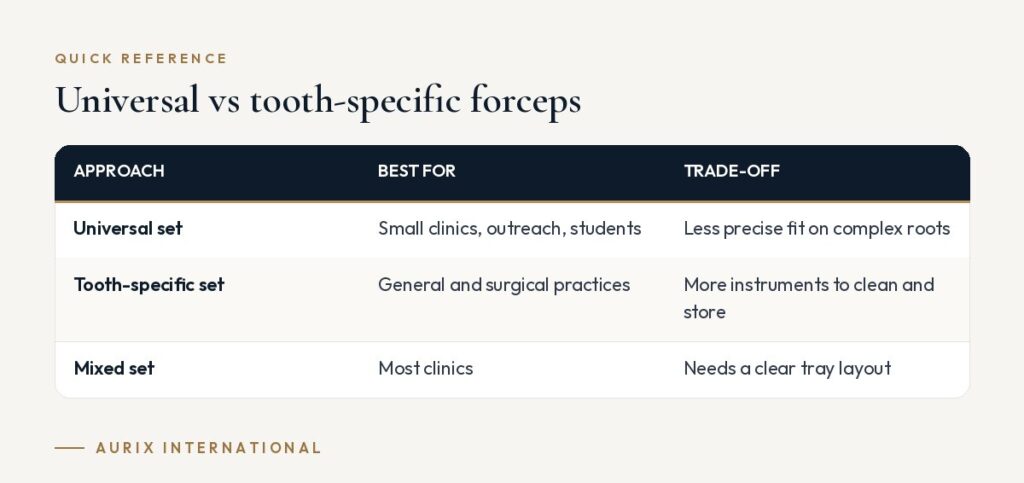
Universal patterns reduce the number of instruments you need, which is useful for a small practice or a mobile clinic. Tooth-specific patterns give better control on difficult extractions and reduce the risk of crown fracture. Most clinics end up with a core of specific patterns plus one or two universals as back-ups.
| Approach | Best for | Trade-off |
|---|---|---|
| Universal set | Small clinics, outreach, students | Less precise fit on complex roots |
| Tooth-specific set | General and surgical practices | More instruments to clean and store |
| Mixed set | Most clinics | Needs a clear tray layout |
Caring for forceps
Clean forceps immediately after use, open the joint during ultrasonic cleaning and sterilisation, and lubricate the hinge with an instrument-grade lubricant. Store them open or in a cassette so the beaks do not knock against other instruments.
Where to buy
Aurix International supplies extraction forceps individually and as part of pre-assembled oral surgery kits. Browse the Oral collection, or contact our team for wholesale pricing and help choosing patterns for your practice.